Franco-Italian War
Last and First MenThe Franco-Italian War was a brief conflict in which a local frontier incident ignited Italy’s existing grievances against France. Its swift defeat exposed the fragility beneath Italy’s manufactured military confidence: the country’s resistance broke down, its dictator was killed, and a new government accepted peace on terms that confirmed French territorial gains.
Background and Causes
After the European War, Italy passed through social disorder and a crisis of self-confidence. A flamboyant but sincere national party then took control, promising renewed standing through social reform and militarization. Trains became punctual, streets cleaner, and public morals more puritanical; Italy also won aviation records. The regime presented these changes as evidence of national revival, while its leader combined practical ability with forceful rhetoric and limited political thought.
The movement cultivated military prestige among the young, who were dressed in uniform, trained with firearms, and encouraged to see themselves as national saviors. They were also used to enforce the government’s will. Meanwhile, the dictator repeatedly proclaimed Italy’s desire to expand. The book connects this demand to Italy’s failure to restrict population growth, as well as to hunger for French territory in Africa and resentment of France’s leadership among Latin peoples. Italian patriots were further angered by France’s protection of people they regarded as traitors.
The Frontier Incident and War
The immediate trigger was a frontier incident: Italian patriots perceived an insult to their flag, after which a small party of Italian militia crossed into French territory without authorization. The raiders were captured, but the incident had already resulted in French deaths. France’s demand for apology and reparation was presented as calm, yet subtly offensive to Italian dignity; the account thus distinguishes the limited initial demand from the political fury it provoked.
Italian patriots worked themselves into a short-sighted anger. The dictator, unwilling to apologize but also unable to ignore the pressure around him, demanded the release of the captive militiamen and ultimately declared war. The conflict moved rapidly from a contained border affair to a national test of prestige, driven less by a considered strategic decision than by the regime’s inability to retreat without appearing to surrender its claims.
Defeat and Political Collapse
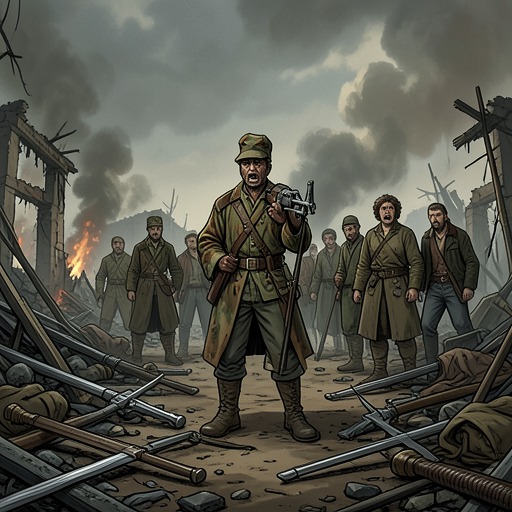
After a single sharp engagement, French armies pressed into northern Italy. Italian resistance was at first described as heroic, but soon descended into chaos. The population, waking from its dream of military glory, turned against the dictator it had itself compelled to declare war. In a theatrical and gallant attempt to dominate the Roman crowd, he failed and was killed.
The new Italian government made peace in haste. Italy ceded a frontier territory to France, although France had already annexed it in the name of security. The settlement therefore formalized a loss that had preceded the treaty, while the rapid change of government revealed how little the dictator’s military spectacle had secured lasting popular support.
Aftermath and Historical Significance
The war altered Italy’s model of national distinction. Italians became less concerned with surpassing Garibaldi’s military glory and more interested in emulating Dante, Giotto, and Galileo. The shift marks a pointed reversal: the regime had tried to cure national self-doubt through martial achievement, but defeat redirected admiration toward artistic and intellectual accomplishment.
France emerged with complete mastery of the European continent, yet the account does not present that dominance as a stable peace. France behaved arrogantly and nervously, conscious of having much to lose, and peace was disturbed again before long. The Franco-Italian War thus serves as an early example of how national prestige, domestic political pressures, and an accidental frontier provocation could turn limited grievances into a war whose consequences outlasted its brief fighting.